


Every living cell depends on a constant movement of substances across its membrane to survive. While some molecules move naturally from areas of high concentration to low concentration, others must travel in the opposite direction. This movement requires energy and is known as active transport. It is one of the most important biological processes because it allows cells to absorb nutrients, remove waste, maintain ion balance, and perform countless life-sustaining functions.
Active transport in Biology plays a vital role in plants, animals, bacteria, and humans. From absorbing minerals through plant roots to transmitting nerve impulses in the human brain, active transport ensures that cells can function even when moving substances against their concentration gradient. Unlike passive transport, this process requires energy in the form of adenosine triphosphate (ATP).
In this comprehensive guide, you’ll learn how active transport works, the types of active transport, real-life examples, its importance in biology and medicine, and how it differs from passive transport. Whether you’re a student, educator, or science enthusiast, this article will help you understand the concept with simple explanations and practical examples.
What Is Active Transport?
Active Transport Definition
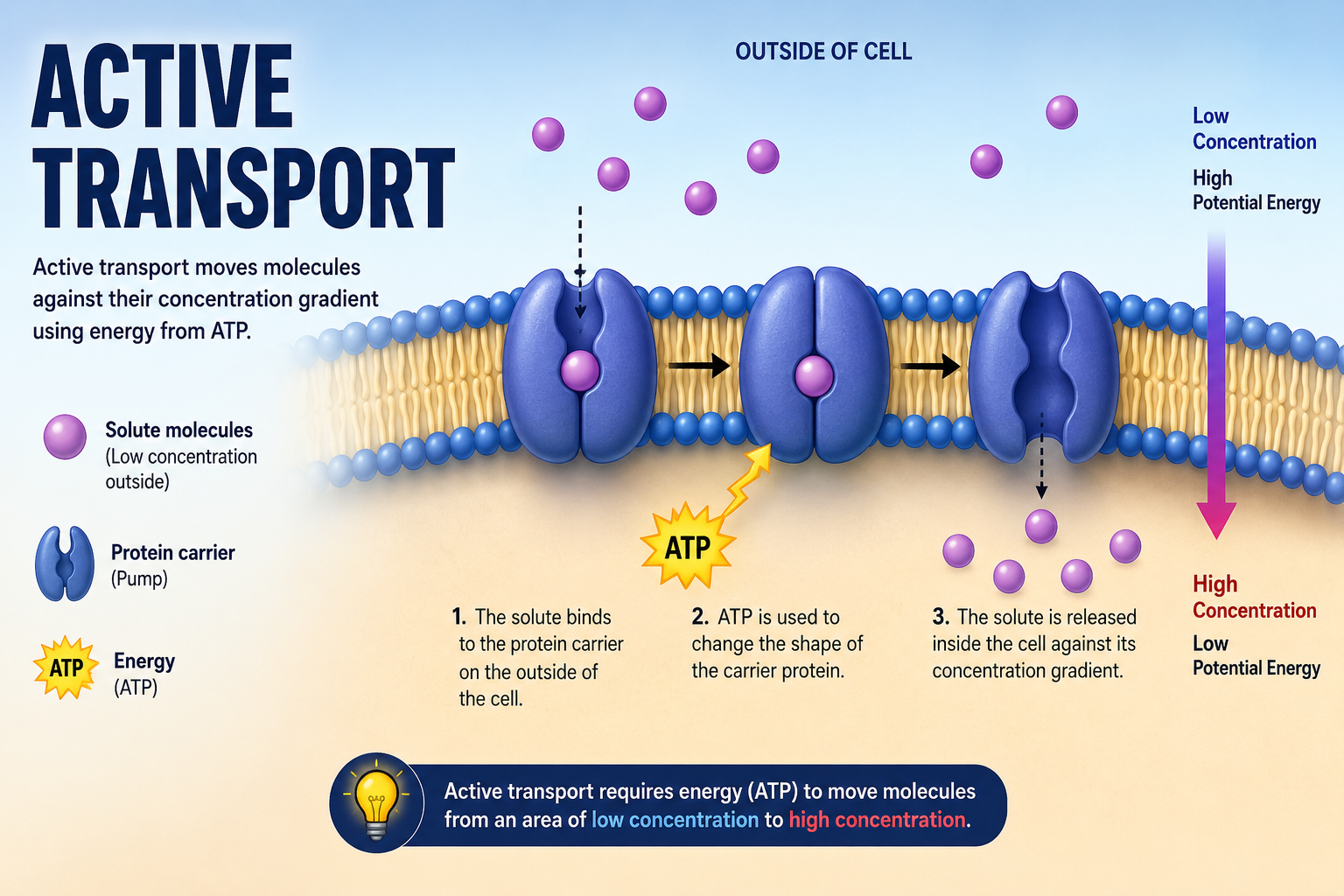
Active transport is the movement of molecules or ions across a cell membrane from an area of lower concentration to an area of higher concentration using cellular energy, usually ATP. Because the movement goes against the natural concentration gradient, cells must expend energy to complete the process.
Unlike diffusion, where substances move naturally, active transport relies on specialized membrane proteins called carrier proteins or pumps. These proteins use energy to transport specific molecules into or out of the cell.
Quick Definition
Active transport is an energy-dependent process that moves substances against their concentration gradient through specialized transport proteins.
Why Cells Need Active Transport
Cells constantly exchange materials with their surroundings. However, many essential nutrients are often present in lower concentrations outside the cell than inside it. Without active transport, cells would not be able to obtain enough nutrients or maintain proper internal conditions.
Some key reasons cells require active transport include:
- Absorbing nutrients efficiently
- Removing harmful waste products
- Maintaining proper ion concentrations
- Supporting nerve and muscle function
- Regulating cellular pH
- Preserving cell homeostasis
Without active transport, normal cellular activities would eventually stop, making life impossible.
How Active Transport Works
Understanding the process becomes easier when broken into simple steps.
Step 1: Molecules Bind to Transport Proteins
Specific molecules or ions first attach to carrier proteins embedded within the cell membrane. These proteins recognize only certain substances, making the process highly selective.
For example, sodium ions bind only to sodium transport proteins, while glucose uses different transporter proteins.
Step 2: ATP Provides Energy
The carrier protein receives energy by breaking down ATP (adenosine triphosphate), often referred to as the cell’s energy currency.
When ATP is hydrolyzed into ADP and phosphate, energy is released. This energy powers the transport protein.
Step 3: Protein Changes Shape
The released energy causes the transport protein to change its three-dimensional shape. This structural change allows the attached molecule or ion to move through the membrane.
Without ATP, this conformational change cannot occur.
Step 4: Molecules Move Against the Concentration Gradient
The transport protein moves the molecule from an area where its concentration is low to an area where it is already high.
This is the defining feature of active transport because the movement occurs against the natural direction of diffusion.
Step 5: Transport Protein Resets
After releasing the transported substance, the protein returns to its original shape and becomes ready to transport another molecule.
This continuous cycle enables cells to regulate the movement of essential substances efficiently.
Key Components of Active Transport
Several components work together to make active transport possible.
Cell Membrane
The cell membrane acts as a selective barrier, controlling which substances enter or leave the cell. Active transport occurs through proteins embedded within this membrane.
Carrier Proteins
Carrier proteins bind specific molecules and transport them across the membrane. Each protein is designed for a particular substance, ensuring accuracy and efficiency.
Examples include:
- Sodium-potassium pumps
- Calcium pumps
- Proton pumps
- Glucose transporters
ATP (Adenosine Triphosphate)
ATP is the primary energy source used during active transport.
Whenever substances need to move against their concentration gradient, ATP supplies the required energy.
Cells continuously produce ATP through cellular respiration, ensuring that transport processes can continue.
Concentration Gradient
A concentration gradient refers to the difference in the amount of a substance between two areas.
Active transport moves molecules from regions of lower concentration toward regions of higher concentration, opposite to the natural direction of movement.
Electrochemical Gradient
For charged particles such as sodium, potassium, and calcium ions, movement depends not only on concentration but also on electrical charge.
The combined influence of concentration and electrical potential is known as the electrochemical gradient, which is especially important in nerve and muscle cells.
Types of Active Transport
Scientists classify active transport into different categories based on how energy is used.
Understanding these 3 types of active transport helps explain how cells transport different molecules efficiently.
Primary Active Transport
Primary active transport directly uses ATP to move molecules across the membrane.
Because ATP supplies energy immediately, this method is considered the most direct form of active transport.
Characteristics
- Uses ATP directly
- Moves ions against the concentration gradient
- Maintains cellular ion balance
- Essential for nerve signaling
Example
The sodium-potassium pump is the best-known example.
It moves:
- Three sodium ions out of the cell
- Two potassium ions into the cell
This process maintains the electrical potential necessary for nerve impulses and muscle contraction.
Other examples include:
- Calcium pumps
- Proton pumps
- Hydrogen-potassium pumps in the stomach
Secondary Active Transport
Secondary active transport does not use ATP directly. Instead, it relies on energy stored in ion gradients created by primary active transport.
This indirect use of energy makes the process highly efficient.
For example, after the sodium-potassium pump establishes a sodium gradient, that stored energy helps transport glucose into intestinal cells.
Characteristics
- Indirect ATP usage
- Depends on ion gradients
- Often transports nutrients
- Highly efficient
Common Examples
- Sodium-glucose cotransporter
- Sodium-amino acid transporter
- Sodium-calcium exchanger
Secondary transport plays a major role in nutrient absorption within the digestive system and kidneys.
Uniport, Symport, and Antiport
Another way to classify transport proteins is by the number and direction of molecules they move.
Uniport
A uniport transports a single type of molecule in one direction.
Example: Glucose transporter proteins.
Symport
A symport moves two different substances in the same direction across the membrane.
Example: Sodium-glucose cotransporter.
Antiport
An antiport transports two substances in opposite directions.
Example: Sodium-potassium pump.
Understanding these transport systems helps explain how nutrients, ions, and waste products move efficiently through living cells.
Examples of Active Transport
Many biological processes rely on active transport every second.
Some of the most important active transport examples include:
- Sodium-potassium pump regulating nerve impulses
- Calcium pumps controlling muscle contraction
- Proton pumps producing stomach acid
- Root hair cells absorbing mineral ions from soil
- Glucose absorption in the small intestine
- Amino acid uptake in intestinal cells
- Kidney tubules reabsorbing essential nutrients
- White blood cells engulfing harmful microorganisms
These examples demonstrate how active transport supports growth, communication, digestion, and overall survival in virtually every living organism.
Active Transport and Passive Transport
Although both active and passive transport move substances across the cell membrane, they differ significantly in how they function. Understanding active transport and passive transport is one of the most important topics in biology because it explains how cells regulate the movement of nutrients, ions, and waste.
Passive transport allows substances to move naturally from an area of higher concentration to an area of lower concentration without using cellular energy. Active transport, on the other hand, requires ATP to move substances against the concentration gradient.
Comparison Between Active and Passive Transport
| Feature | Active Transport | Passive Transport |
| Energy Requirement | Requires ATP | No energy required |
| Direction of Movement | Low to high concentration | High to low concentration |
| Concentration Gradient | Moves against the gradient | Moves along the gradient |
| Transport Proteins | Usually required | Sometimes required |
| Speed | Generally slower due to energy use | Usually faster |
| Examples | Sodium-potassium pump, proton pump | Diffusion, osmosis, facilitated diffusion |
| Purpose | Maintain homeostasis and absorb nutrients | Equalize concentration differences |
Knowing these differences helps students understand why some molecules need energy to enter or leave the cell while others move naturally.
Active Transport in Biology
Active transport in Biology is essential for maintaining life. Every living organism—from tiny bacteria to large mammals—depends on this process to regulate internal conditions.
Cells continuously transport ions, nutrients, and other molecules to maintain a stable internal environment, known as homeostasis. Without active transport, cells would lose their ability to communicate, absorb nutrients, and eliminate waste.
Some important biological functions include:
- Maintaining proper salt balance
- Transporting glucose into cells
- Absorbing amino acids
- Regulating water balance
- Supporting cellular metabolism
- Producing electrical signals in nerve cells
These processes occur continuously throughout the body, often without us realizing it.
Active Transport in Plants
Plants cannot move to search for nutrients, so they rely heavily on active transport.
Root hair cells absorb essential minerals from the soil even when mineral concentrations are lower outside the roots than inside them.
Important minerals transported actively include:
- Potassium
- Nitrate
- Phosphate
- Magnesium
- Calcium
Without active transport, plants would struggle to obtain enough nutrients for photosynthesis, growth, and reproduction.
Example
A plant growing in nutrient-poor soil still absorbs nitrate ions through active transport because specialized membrane proteins use ATP to move these ions into root cells.
Active Transport in Animals
Animals use active transport throughout the body to maintain normal physiological functions.
Examples include:
Nutrient Absorption
Cells lining the small intestine actively absorb glucose and amino acids after digestion.
Kidney Function
The kidneys recover essential nutrients and ions from filtered blood through active transport, preventing valuable substances from being lost in urine.
Muscle Function
Calcium pumps regulate calcium levels, allowing muscles to contract and relax properly.
Nerve Impulses
The sodium-potassium pump creates electrical gradients necessary for transmitting nerve signals throughout the nervous system.
Active Transport in the Human Body
The human body depends on active transport every second.
Brain
Neurons maintain electrical gradients using sodium-potassium pumps.
Without these pumps, nerve impulses would stop almost immediately.
Digestive System
Cells lining the intestines absorb nutrients through secondary active transport.
This ensures efficient nutrient uptake even when concentrations inside the cells are already high.
Kidneys
The kidneys use active transport to reclaim:
- Glucose
- Sodium
- Calcium
- Amino acids
- Water (indirectly)
This process helps maintain fluid balance and prevents nutrient loss.
Heart
Heart muscle cells require carefully controlled sodium, potassium, and calcium levels.
Active transport maintains these ion concentrations, allowing the heart to beat rhythmically.
Immune System
White blood cells rely on active transport to absorb nutrients and carry out immune responses effectively.
Why Active Transport Is Important
Active transport is one of the most critical cellular processes because it allows organisms to survive in constantly changing environments.
Some major functions include:
Maintains Homeostasis
Cells regulate internal conditions regardless of changes in their surroundings.
Absorbs Essential Nutrients
Nutrients like glucose and amino acids can be absorbed even when their concentrations are low.
Removes Waste Products
Cells actively transport harmful substances out to maintain healthy internal conditions.
Supports Nerve Transmission
Electrical impulses depend on sodium and potassium gradients created through active transport.
Enables Muscle Contraction
Calcium pumps regulate calcium ions that trigger muscle movement.
Regulates pH
Hydrogen ion pumps help maintain proper acid-base balance inside cells.
Powers Cellular Communication
Cells exchange signals through ion movements made possible by active transport.
Active Transport Examples
Understanding real-life examples makes this concept easier to remember.
Sodium-Potassium Pump
Perhaps the most famous example of active transport.
For every ATP molecule used:
- Three sodium ions leave the cell.
- Two potassium ions enter the cell.
This pump supports nerve impulses, muscle contraction, and overall cellular function.
Proton Pump
Proton pumps transport hydrogen ions across membranes.
Examples include:
- Producing stomach acid
- Supporting ATP production in mitochondria
- Maintaining cellular pH
Calcium Pump
Calcium pumps remove calcium from the cytoplasm after muscle contraction, allowing muscles to relax.
Sodium-Glucose Cotransporter
This is an example of secondary active transport.
It uses the sodium gradient established by primary active transport to move glucose into intestinal and kidney cells.
Mineral Uptake in Plants
Plant roots actively absorb minerals such as nitrate and potassium from the soil.
Iron Absorption
Cells in the small intestine actively transport iron into the bloodstream, supporting the production of healthy red blood cells.
Diseases Related to Active Transport
When active transport systems fail, serious health problems can occur.
Cystic Fibrosis
Although primarily caused by defective chloride channels, disruptions in ion transport affect water movement and mucus production.
Symptoms include:
- Thick mucus
- Frequent lung infections
- Digestive problems
Heart Disorders
Abnormal sodium or potassium transport can lead to irregular heart rhythms and reduced cardiac function.
Kidney Disorders
Defective transport proteins may reduce the kidneys’ ability to reabsorb nutrients, causing excessive nutrient loss in urine.
Diabetes
Glucose transporters play an essential role in controlling blood sugar levels.
Researchers continue studying transport proteins to improve diabetes treatments.
Neurological Disorders
Impaired ion transport may contribute to certain neurological diseases by disrupting communication between nerve cells.
Clinical Importance of Active Transport
Healthcare professionals study active transport because many medicines target transport proteins.
Examples include:
- Drugs that reduce stomach acid by inhibiting proton pumps.
- Medications that affect sodium transport to regulate blood pressure.
- Treatments that influence calcium transport in heart disease.
- Research into drug delivery systems that use transport proteins to move medicines into cells.
Understanding these mechanisms has improved treatments for digestive disorders, cardiovascular diseases, and metabolic conditions.
Real-World Applications of Active Transport
The importance of active transport extends far beyond biology classrooms. Scientists, doctors, and researchers use their understanding of this process to develop new treatments and technologies.
Medicine
Many medications work by affecting transport proteins in cell membranes. For example, proton pump inhibitors (PPIs) reduce stomach acid production by blocking proton pumps, providing relief from acid reflux and stomach ulcers.
Drug Delivery
Researchers are designing medicines that use natural transport proteins to deliver drugs directly into cells. This targeted approach may improve treatment effectiveness while reducing side effects.
Biotechnology
Biotechnology companies modify transport proteins in microorganisms to improve the production of medicines, enzymes, and biofuels.
Agriculture
Scientists study active transport in plants to develop crops that absorb nutrients more efficiently. These advances can improve crop yields and reduce fertilizer use.
Medical Research
Transport proteins are being investigated as potential treatment targets for cancer, neurological disorders, and inherited metabolic diseases.
Everyday Examples to Understand Active Transport
Complex scientific concepts become easier when compared with everyday situations.
Pumping Water Uphill
Imagine pumping water from the bottom of a hill to the top. Since the water naturally wants to flow downhill, energy is needed to move it upward. Active transport works in the same way by moving substances against their natural direction.
Elevator
An elevator carries people to higher floors by using electricity. Similarly, cells use ATP to move molecules where they are needed.
Escalator
Walking up an upward-moving escalator requires energy. Active transport also requires energy to move substances against the concentration gradient.
Charging a Battery
Charging a battery stores energy for future use. In the same way, active transport creates ion gradients that cells later use for important processes like nerve signaling.
Common Misconceptions About Active Transport
Many students misunderstand this topic. Clearing up these misconceptions can improve learning.
Misconception 1: Active Transport Does Not Need Energy
Fact: Active transport always requires energy, either directly from ATP or indirectly from ion gradients.
Misconception 2: Active Transport and Diffusion Are the Same
Fact: Diffusion is a passive process, while active transport requires energy.
Misconception 3: Osmosis Is Active Transport
Fact: Osmosis is a form of passive transport because water moves naturally without ATP.
Misconception 4: Only Animal Cells Use Active Transport
Fact: Plant cells, bacteria, fungi, and other living organisms also rely on active transport.
Misconception 5: All Active Transport Uses ATP Directly
Fact: Only primary active transport uses ATP directly. Secondary active transport uses energy stored in ion gradients.
Common Student Mistakes
Students preparing for biology exams often make similar errors.
Avoid these common mistakes:
- Confusing active transport with passive transport.
- Forgetting that ATP is required.
- Mixing up primary and secondary active transport.
- Confusing symport and antiport.
- Assuming all molecules can pass through the membrane without transport proteins.
Remembering these points can improve exam performance and deepen your understanding of cell biology.
Quick Revision Summary
Here is a concise review of the key concepts:
- Active transport moves substances from low concentration to high concentration.
- ATP provides the energy required for the process.
- Carrier proteins or pumps transport specific molecules.
- The two main categories are primary active transport and secondary active transport.
- Common transport systems include uniport, symport, and antiport.
- The sodium-potassium pump is the most well-known example.
- Active transport supports nutrient absorption, waste removal, nerve impulses, muscle contraction, and homeostasis.
- Plants, animals, bacteria, and humans all depend on active transport for survival.
If you’re preparing a classroom presentation or revision notes, creating an Active transport PPT with diagrams, comparison tables, and real-life examples can make the concept easier to understand and remember.
Conclusion
Active transport is a fundamental biological process that enables cells to move substances against their concentration gradient using energy. From nutrient absorption in the digestive system to nerve impulse transmission and mineral uptake in plants, it plays a crucial role in the survival of every living organism.
Understanding active transport in Biology provides valuable insight into how cells maintain homeostasis, communicate, and perform specialized functions. By learning the types of active transport, recognizing important active transport examples, and understanding the differences between active transport and passive transport, students and science enthusiasts can build a strong foundation in cell biology.
Whether you are studying for an exam, teaching biology, or simply expanding your scientific knowledge, mastering active transport will help you better appreciate the remarkable mechanisms that keep living cells functioning efficiently.
Frequently Asked Questions (FAQs)
1. What is active transport?
Active transport is the movement of molecules or ions across a cell membrane against their concentration gradient using energy, usually in the form of ATP.
2. What are the 3 types of active transport?
The commonly recognized 3 types of active transport are:
- Primary active transport
- Secondary active transport
- Transport based on carrier mechanisms such as uniport, symport, and antiport
3. What is the difference between active transport and passive transport?
Active transport requires energy and moves substances against the concentration gradient, whereas passive transport requires no energy and moves substances down the concentration gradient.
4. What is the best example of active transport?
The sodium-potassium pump is the most widely studied example. It pumps three sodium ions out of the cell and two potassium ions into the cell using ATP.
5. Why is ATP important in active transport?
ATP supplies the energy needed for transport proteins to change shape and move molecules against their natural concentration gradient.
6. Where does active transport occur in the human body?
Active transport occurs in many organs, including the intestines, kidneys, brain, muscles, and stomach, where it supports nutrient absorption, nerve signaling, muscle contraction, and acid secretion.
7. Why is active transport important in biology?
Active transport is essential because it helps maintain homeostasis, absorbs nutrients, removes waste, regulates ion balance, and enables vital cellular processes necessary for life.
You May Also Read: social media jobs