


Understanding the cube volume formula is one of the first steps in learning three-dimensional geometry. Whether you’re a Class 6 or Class 8 student, preparing for competitive exams, or simply brushing up on math skills, knowing how to calculate the volume of a cube is an essential concept.
A cube is a three-dimensional shape with all sides equal in length. Because of its simple structure, finding its volume is straightforward once you understand the formula. From calculating the capacity of storage boxes to solving school assignments and engineering problems, the volume of a cube formula has many practical uses in everyday life.
In this guide, you’ll learn what cube volume means, why the formula works, how to calculate it step by step, and how it compares with the Volume of cuboid formula. You’ll also discover practical examples, common mistakes to avoid, and real-life applications that make learning easier.
What Is a Cube?
A cube is a three-dimensional solid object made up of six identical square faces. Every edge of a cube has the same length, making it one of the simplest geometric shapes.
Unlike a cuboid, where the length, width, and height can differ, every dimension of a cube is equal. This unique property makes calculating its volume much easier.
You can find cubes all around you. Dice, Rubik’s Cubes, sugar cubes, toy blocks, and ice cubes are all common examples of cubes.
Properties of a Cube
A cube has several important characteristics:
- Six square faces
- Twelve equal edges
- Eight vertices (corners)
- All angles measure 90°
- Opposite faces are parallel
- All edges have equal length
These properties help explain why a cube uses only one measurement—the side length—to calculate its volume.
What Is Volume?
Volume refers to the amount of space a three-dimensional object occupies. It tells us how much material or capacity an object contains.
For example, if you fill a cube-shaped container with water, the amount of water it can hold is its volume.
Volume is always measured in cubic units, such as:
- cm³
- m³
- mm³
- ft³
- in³
Many students confuse area with volume, but they measure different things.
| Feature | Area | Volume |
| Dimension | Two-dimensional | Three-dimensional |
| Measures | Surface | Space occupied |
| Units | Square units (cm²) | Cubic units (cm³) |
| Formula Example | Area of cube faces: 6s² | s³ |
Understanding this difference helps prevent one of the most common mistakes in geometry.
Cube Volume Formula
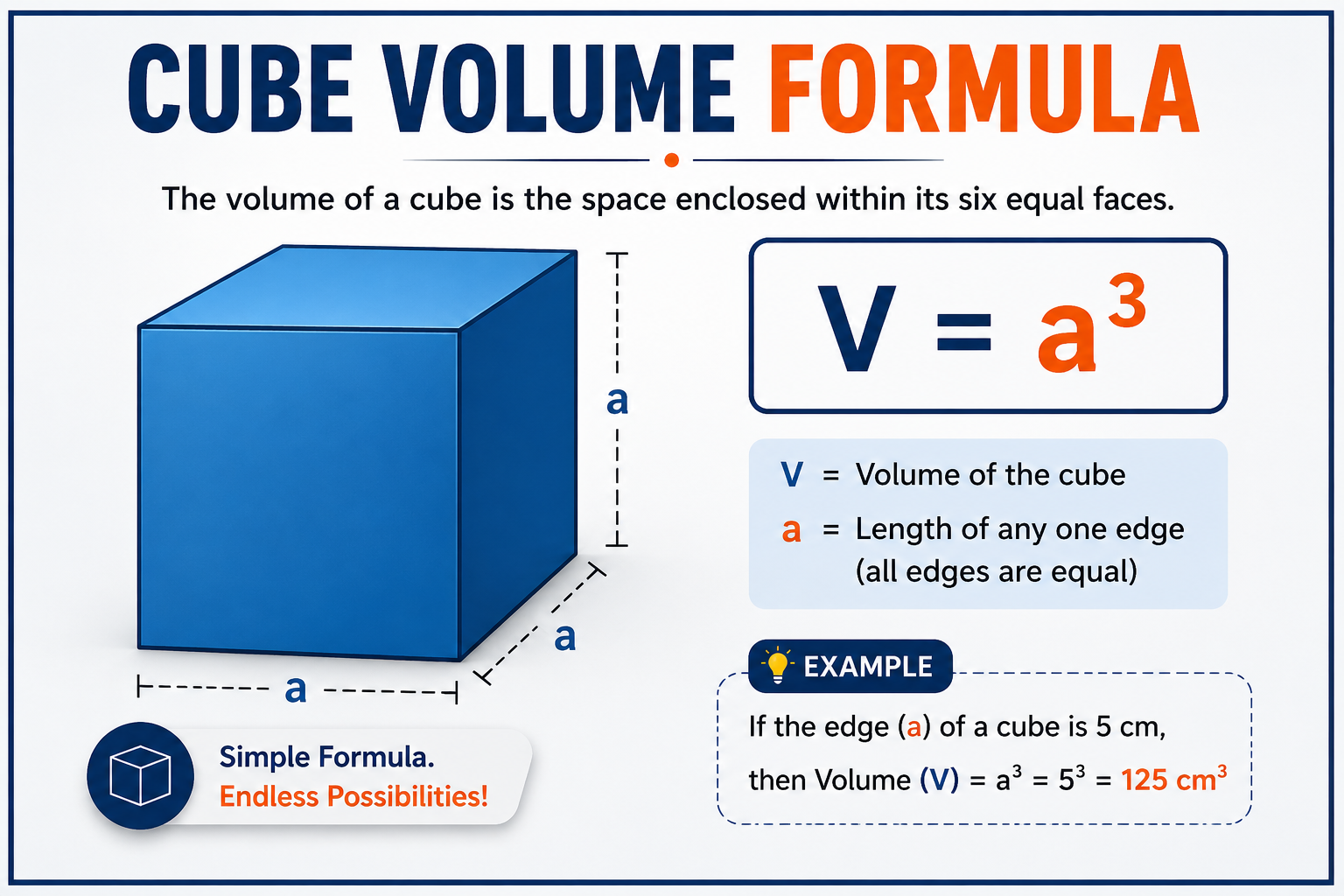
The cube volume formula is:
Volume = Side × Side × Side
or
V = s³
Where:
- V = Volume
- s = Length of one side of the cube
Since every edge of a cube is identical, you only need one measurement to calculate the volume.
For example, if each side measures 4 cm:
Volume = 4 × 4 × 4 = 64 cm³
This means the cube occupies 64 cubic centimeters of space.
The Volume of cube formula Class 6 curriculum usually introduces this concept using simple whole numbers. By Volume of cube formula Class 8, students solve more advanced word problems involving larger numbers and unit conversions.
Why Does the Cube Volume Formula Work?
Many students memorize the formula without understanding why it works.
Let’s simplify it.
Every rectangular prism uses this formula:
Volume = Length × Width × Height
A cube is a special rectangular prism where:
- Length = Side
- Width = Side
- Height = Side
So the formula becomes:
Side × Side × Side
or
s × s × s = s³
This is why the exponent 3 appears in the formula. It represents multiplying the side length three times.
Once you understand this concept, remembering the formula becomes much easier.
Understanding Cubic Units
The answer to every volume question must be written in cubic units.
For example:
- Side = 5 cm
- Volume = 125 cm³
Notice that the unit becomes cubic because the side length is multiplied three times.
Some common cubic units include:
| Unit | Meaning |
| mm³ | Cubic millimeters |
| cm³ | Cubic centimeters |
| m³ | Cubic meters |
| ft³ | Cubic feet |
| in³ | Cubic inches |
Always include the correct unit in your final answer to avoid losing marks in exams.
Step-by-Step Guide to Calculate Cube Volume
Finding the volume of a cube is simple if you follow these steps.
Step 1: Measure One Side
Measure the length of any edge.
Since every side is equal, measuring one edge is enough.
Example:
Side = 6 cm
Step 2: Cube the Side Length
Multiply the side by itself three times.
6 × 6 × 6
= 216
Step 3: Write the Correct Unit
The final answer becomes:
216 cm³
Remember, the unit is cubic because volume measures three-dimensional space.
Volume of a Cube Example
Let’s solve an easy example.
Question:
A cube has a side length of 7 cm. Find its volume.
Solution
Formula:
V = s³
Substitute the value:
V = 7³
V = 7 × 7 × 7
V = 343 cm³
Answer: 343 cubic centimeters
This Volume of a cube Example demonstrates how quickly you can solve cube volume problems using the formula.
Cube Volume Formula vs Volume of Cuboid
Students often confuse these formulas because both calculate volume.
Here’s a simple comparison.
| Shape | Formula | Measurements Needed |
| Cube | s³ | One side |
| Volume of cuboid | l × w × h | Length, width, height |
A cube has equal dimensions, while a cuboid usually has three different dimensions.
For example:
Cube
Side = 5 cm
Volume = 125 cm³
Cuboid
Length = 5 cm
Width = 4 cm
Height = 3 cm
Volume = 60 cm³
Understanding this difference helps you choose the correct formula during exams.
Relationship Between Area and Volume
Another topic students frequently study alongside volume is the Area of cube.
The surface area formula is:
Surface Area = 6 × s²
This measures the total area of all six square faces.
In contrast, volume measures the space inside the cube.
Knowing both formulas helps solve a wider range of geometry questions.
Volume and Surface Area Formula Together
Students sometimes search for the Volume of cube surface area formula because both concepts are closely related.
Here’s a quick summary:
| Measurement | Formula |
| Volume | s³ |
| Surface Area | 6s² |
| Lateral Surface Area | 4s² |
Although these formulas use the same side length, they measure completely different properties of the cube.
Common Mistakes to Avoid
Even simple formulas can lead to errors if you’re not careful.
Avoid these common mistakes:
- Forgetting to cube the side length.
- Writing square units instead of cubic units.
- Using the cuboid formula for a cube.
- Mixing different units without converting them first.
- Confusing surface area with volume.
- Performing multiplication incorrectly.
Checking your calculations carefully can help you avoid unnecessary mistakes.
Quick Memory Trick
A simple way to remember the cube volume formula is:
Cube = Three Equal Sides
Think:
Side × Side × Side
or
s³
Since a cube has three equal dimensions, the exponent 3 becomes easy to remember.
Another trick is to picture stacking tiny cubes inside a larger cube. Each layer adds another dimension, creating volume rather than just area.
Finding the Side Length from Volume
Sometimes, instead of finding the volume, you’ll be given the volume and asked to calculate the side length of the cube. In this case, you use the cube root of the volume.
Formula:
Side = ∛Volume
Let’s look at a few examples.
Example 1
Question: A cube has a volume of 64 cm³. Find the side length.
Solution:
Side = ∛64
Side = 4 cm
Example 2
Question: A cube has a volume of 125 cm³. Find the side length.
Solution:
Side = ∛125
Side = 5 cm
Example 3
Question: A cube has a volume of 512 cm³. Find the side length.
Solution:
Side = ∛512
Side = 8 cm
Learning cube roots makes solving reverse geometry problems much easier and is an important skill for higher-level mathematics.
Cube Volume Unit Conversion
In geometry, you may need to convert one cubic unit into another before applying the formula. Always convert the side length to the same unit before calculating the volume.
| Cubic Unit | Equivalent |
| 1 cm³ | 1,000 mm³ |
| 1 m³ | 1,000,000 cm³ |
| 1 ft³ | 1,728 in³ |
| 1 Litre | 1,000 cm³ |
Example
A cube has a side length of 50 mm.
Convert millimeters to centimeters:
50 mm = 5 cm
Now calculate:
Volume = 5³ = 125 cm³
Converting units first helps prevent incorrect answers.
Real-Life Applications of the Cube Volume Formula
The cube volume formula blog calculator and manual calculations are useful in many real-world situations. Understanding cube volume is not just for passing exams—it has practical value in everyday life and many professions.
Storage Boxes
Manufacturers calculate the volume of cube-shaped storage containers to determine how much they can hold.
Ice Cubes
An ice cube tray produces cubes with equal sides. Knowing the volume helps estimate how much water each cube contains.
Dice and Board Games
Standard dice are cubes. Their dimensions are carefully measured during manufacturing to ensure fairness.
Rubik’s Cube
Although a Rubik’s Cube contains many smaller cubes, the overall object is still a cube, making volume calculations straightforward.
Packaging Industry
Companies use cube volume to design shipping boxes that maximize storage space while minimizing material costs.
Construction
Builders calculate the volume of cube-shaped concrete blocks and decorative structures for accurate material estimates.
Education
Teachers use cube models to help students visualize three-dimensional space and understand the difference between area and volume.
Practice Questions
Test your understanding with these questions.
Beginner
- Find the volume of a cube with a side length of 3 cm.
- A cube has a side length of 9 cm. What is its volume?
- Calculate the volume of a cube whose side measures 12 cm.
Intermediate
- The volume of a cube is 343 cm³. Find its side length.
- A cube-shaped tank has sides measuring 2.5 m. Calculate its volume.
Advanced
- A cube-shaped container has a volume of 729 cm³. Find the side length.
- If each edge of a cube doubles, how many times greater is its volume?
Answers
- 27 cm³
- 729 cm³
- 1,728 cm³
- 7 cm
- 15.625 m³
- 9 cm
- Eight times greater
Quick Revision Cheat Sheet
| Topic | Formula |
| Volume of a Cube | V = s³ |
| Side from Volume | s = ∛V |
| Surface Area of Cube | 6s² |
| Lateral Surface Area | 4s² |
| Cuboid Volume | l × w × h |
Keep this table handy for quick revision before tests or exams.
Exam Tips
- Always identify whether the shape is a cube or a cuboid before selecting a formula.
- Write all answers using cubic units.
- Double-check multiplication when cubing a number.
- Convert units before performing calculations.
- Read word problems carefully to determine whether you’re finding volume or side length.
These simple habits can help you avoid common exam mistakes.
Why Learning the Cube Volume Formula Matters
The volume of a cube formula is one of the most fundamental concepts in geometry. It provides the foundation for learning about more advanced three-dimensional shapes such as cuboids, cylinders, cones, prisms, and spheres.
Whether you’re studying the Volume of cube formula Class 6, progressing to the Volume of cube formula Class 8, or preparing for competitive exams, mastering this concept improves your mathematical confidence and problem-solving skills.
It also develops logical thinking and spatial reasoning, which are valuable in engineering, architecture, construction, manufacturing, computer graphics, and many scientific fields.
Conclusion
The cube volume formula is a simple yet essential mathematical concept that helps measure the space inside a cube. Since all edges of a cube are equal, calculating its volume requires only one measurement, making the formula V = s³ both efficient and easy to remember.
By understanding how the formula is derived, practicing solved examples, learning unit conversions, and recognizing the difference between volume and surface area, you can solve geometry problems with greater accuracy and confidence. Whether you’re a student, teacher, or lifelong learner, mastering this concept lays a strong foundation for more advanced topics in mathematics and real-world problem-solving.
Continue practicing with different side lengths and word problems, and you’ll quickly become comfortable applying the volume of a cube formula in both academic and practical situations.
Frequently Asked Questions
What is the cube volume formula?
The cube volume formula is V = s³, where s is the length of one side of the cube.
Why is the exponent 3 used in the formula?
A cube has three equal dimensions—length, width, and height—so the side length is multiplied three times.
What units are used for cube volume?
Cube volume is measured in cubic units, such as cm³, m³, mm³, ft³, and in³.
How do I find the side length if the volume is given?
Take the cube root of the volume using the formula:
Side = ∛Volume
What is the difference between a cube and a cuboid?
A cube has all sides equal, while a cuboid may have different lengths, widths, and heights. Therefore, a cube uses s³, whereas a cuboid uses length × width × height.
Is surface area the same as volume?
No. Surface area measures the total area of all outer faces, while volume measures the space inside the cube.
Where is the cube volume formula used in real life?
It is used in construction, packaging, manufacturing, engineering, storage planning, architecture, education, and many everyday measurement tasks.
You May Also Read: butterfly knife